

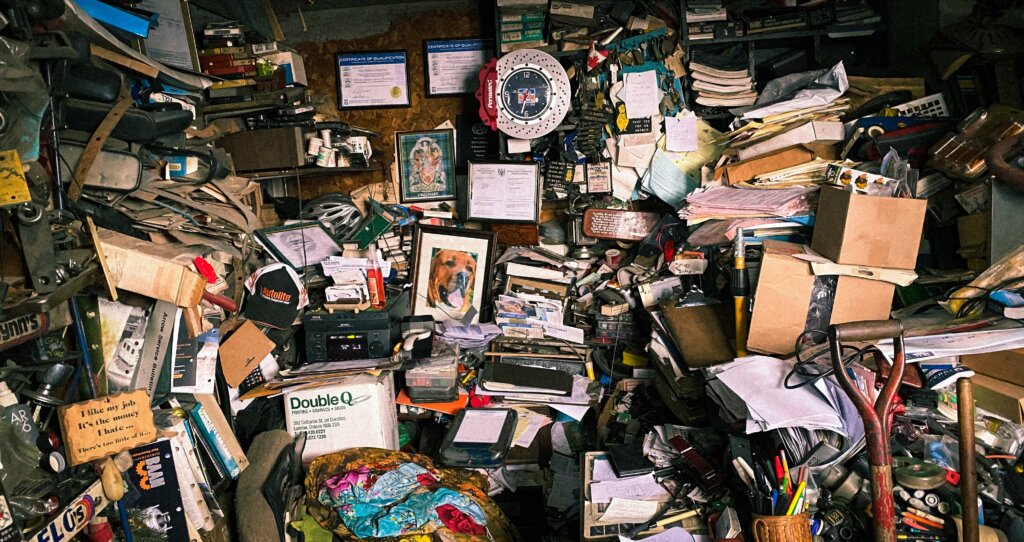
An excerpt from “Hoarding: It’s So Much More Than Clutter”:
My first exposure to hoarding was an event that happened early in my real estate investing career. Many years before I was born, my mother became estranged from her mother. Because of this estrangement, I never met my grandmother.
In July 2002, I received an odd phone call. The man on the other end of the phone wanted to know if I knew my mother. He seemed cagey as he tried to pump me for information about my mom. As we talked, I realized he was calling to tell me that someone in my family had passed away. Without knowing for sure, I figured it must be my grandmother. The one thing I was certain about was that my mom was my grandmother’s only heir.
My grandmother lived in a beautiful home on a golf course in Palm Springs—a very desirable area. When my mother and I contacted the coroner’s office, he confirmed that my grandmother had indeed passed away and my mother had inherited the property. We were told there was a huge problem with the house. My grandmother had been hoarding for years, and the house was crammed full of stuff. It was uninhabitable and unsafe. In fact, it was so unsafe that the coroner had to act soon. They could empty the house and hold an auction to sell anything usable to pay for cleaning it.
My grandmother’s death was hard on my mom because she felt guilty for not talking to her mom in over 40 years. Then to learn that her mom, who had always been prim and proper, who had been a home economics teacher and impeccable housekeeper, and who had been president of the Soroptimist Club for years—a pillar of the community—had been living in such a mess was heartbreaking. At that time, my mother lived over six hundred miles away and had several health issues of her own. I only knew a little bit about real estate, but I already owned a few rentals of my own and my own home.
Another reason managing my grandmother’s death was difficult was that my mom was unable to be there in person to manage the cleanup and to sell the property. Because I lived much closer to Palm Springs, I agreed to oversee the details for her.
I learned from her neighbors that my grandmother was well-known in her community. They told me my grandmother had been losing weight for years and had grown quite thin. The people who knew her were worried and often brought her food, but she never let anybody into her house. Instead of eating much of the food or disposing of the leftovers, my grandmother simply stacked the plates all around her house. When the food began to rot, it attracted rats and other animals into her house.
It was all rather surreal. We were walking into this mid-century home in Palm Springs, located on a golf course—a $1,000,000 home—and it was the coroner who was letting us in. It was incredibly quiet as we stepped inside the house. Everywhere we looked, we saw pile after pile of things. There were stacks of dishes with dried food on them sliding off the counters, bookshelves, and furniture. There were stacks of books with dust flowing from them, and bankers’ boxes stacked up along the walls. The curio cabinets were stuffed with dust-encrusted keepsakes. Clothes were piled waist high, and the carpet was covered with mouse droppings and huge dust bunnies. At that point, we had only stepped into the living room, just past the foyer.
Then we walked around the outside of the house, trying to look through the windows into the rest of the house. The bedrooms had dusty, grimy curtains hanging by the windows; the glass of the windows was so dirty that we couldn’t see through them. We then went around to the back of the house, where the sliding glass doors led to a game room. In the game room, the pool table was covered in dust and Halloween-style spider webs. More stuff was in boxes stacked up high against the walls. But what I remember even more than the dusty pool table were those spooky spider webs.
The whole idea of my grandmother living in such conditions was very upsetting for my mom. What I have learned since then, as an experienced real estate professional, is that hoarding isn’t unusual among older people who live alone, like my grandmother.
In my career, I have run into numerous hoarding situations, and I know the impact hoarding has on the relatives left to manage it. I now understand a lot about hoarding and how to manage the challenges that come with it. Over my 30 years in the real estate business, I have also learned ways to help people manage this situation, improve their living conditions and health, and salvage the value of their homes.
Keep reading: Request your FREE copy of Hoarding: It’s So Much More Than Clutter.
What is Hoarding?
No, a messy desk or occasional dishes left in the sink isn’t hoarding. Hoarding isn’t a small collection of teacups in a cabinet or a few more books than your bookcase can hold. It’s not even that stack of boxes in the garage you’ll get to “one day.”
According to the DSM-5, the American Psychiatric Association’s guide for diagnosing mental disorders, Hoarding Disorder is defined as “a persistent difficulty discarding or parting with possessions, regardless of their actual value.” It continues, specifying that the difficulty in discarding possessions ultimately congests living areas and substantially compromises their intended use and safety.
Hoarding creeps up on you. And even when the hoard becomes dangerous and overwhelming, it can be hard for a hoarder to ask for or accept help, especially when help might insist on cleaning out their treasured possessions.
The International OCD Foundation has resources for finding therapists, support groups, and treatment programs for hoarders.
However, for many, like my grandmother, their family doesn’t realize there is an issue until it is too late, and they’re left behind with the home and hoard they’ve inherited.
Can You Sell a Hoarder Home?
Yes. Having a home with an excess of belongings can make selling seem impossible, but it is absolutely possible.
Instead of going the traditional real estate route and listing your home on the market, which would require inspections, cleaning, viewings, and repairs—an emotionally and financially draining endeavor—consider selling your home as-is to a cash homebuyer you trust.
In these situations, me and my homebuying team at Laurel Buys Houses always communicate with compassion, understanding, and confidentiality. We know from personal experience how difficult it can be to let go and we won’t judge. We’ll buy your home as-is—no repairs, no cleaning, no inspections—and ensure your unwanted items go to someone in need through donations to local churches, veterans groups, and charities in Sacramento. As we clean and restore your home, we’ll even look for important documents and sentimental items and ensure they’re returned to you.

If you or a loved one are struggling with hoarding and thinking about selling and starting fresh, call me at (916) 476-2381.
We can help.
Meta description: Hoarding impacts many Sacramento families. Read a real story and discover trusted local options for selling a hoarder home as-is.